The Falklands Fallacy: Why You Can’t Compare 1982 to the Modern Royal Navy
By Allied Dispatch UK
Whenever the Royal Navy (RN) faces a new crisis, be it in the Red Sea or the Indo-Pacific, the same nostalgic question inevitably resurfaces in the press: "Could we still send a Task Force as we did in 1982?"
The answer is technically "No," but the reason isn't just about budget cuts. It’s because naval warfare has fundamentally changed. Comparing the 1982 fleet to the 2026 fleet is like comparing a 1980s mainframe computer to a modern smartphone; one has physical mass, the other has concentrated, world-ending capability.
Here is why the "Falklands Yardstick" is a broken tool for measuring modern British sea power.
1. Capability vs. Capacity: The 'One-to-Many' Rule
In 1982, the RN sent 23 destroyers and frigates. Today, we have 13. On paper, that looks like a terminal decline. However, the Type 45 Destroyer is not a "replacement" for a Type 42; it is a quantum leap.
- In 1982: A Type 42 destroyer could track a handful of targets and fire its Sea Dart missiles one or two at a time. It was overwhelmed by "saturation attacks" (multiple missiles arriving at once).
- In 2026: A single Type 45, equipped with the Sampson radar and Sea Viper (Aster) missiles, can track over 1,000 targets the size of a cricket ball and engage dozens simultaneously.
One Type 45 arguably has more localised air-defence "weight" than the entire 1982 Task Force combined. We no longer need 20 ships to provide a "picket line" when one ship can see over the horizon in 360 degrees.
2. The Death of 'Point Defence'
The Falklands War was a war of "iron bombs." Argentine pilots had to fly directly over British ships to drop unguided munitions. Today, we live in the era of A2/AD (Anti-Access/Area Denial).
Modern threats like the P-800 Oniks or hypersonic cruise missiles can be launched from 300 miles away. In 1982, a ship without a missile system could still contribute with a 4.5-inch gun. In 2026, a ship without an advanced digital combat system is just a target. We cannot trade quality for quantity because "low-quality" ships do not survive for more than five minutes in a modern high-threat environment.
3. The 'Invincible' vs. 'Queen Elizabeth' Class
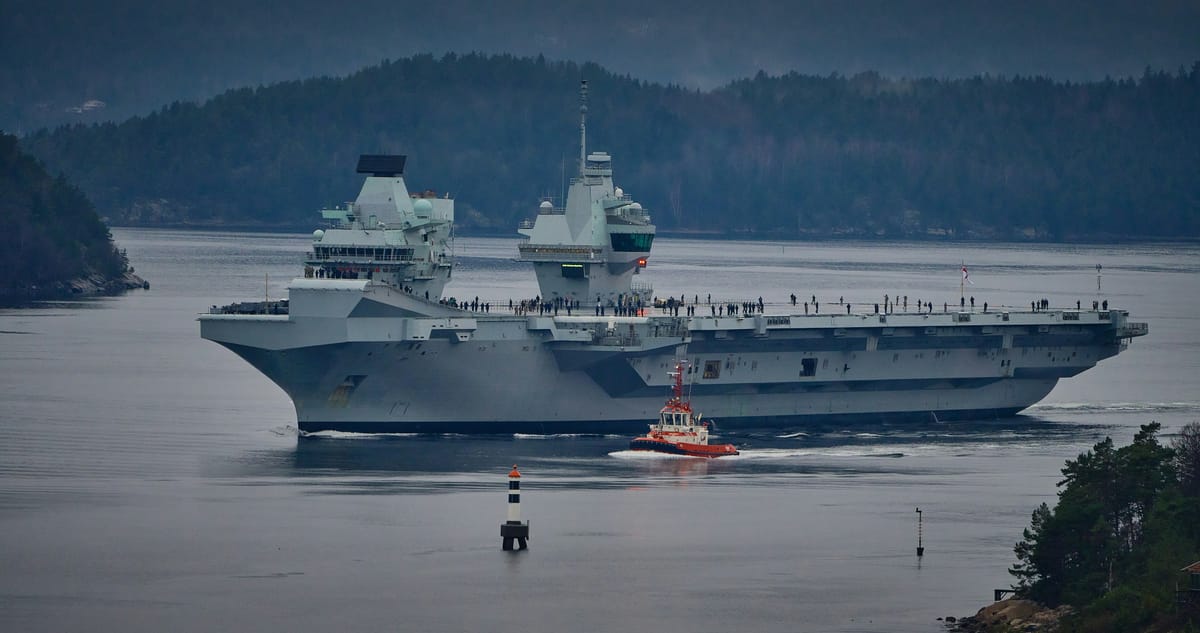
Critics note that we had two carriers in 1982 (HMS Hermes and Invincible) and we have two now. But the comparison ends there.
- The Air Wing: The Sea Harrier was a miracle worker, but it had its limits. The F-35B Lightning II is a 5th-generation "stealth node" that can destroy enemy jets before they even know a British carrier is in the area.
- The Deck: HMS Queen Elizabeth is three times the size of Invincible. It can generate more "sorties" (flights) in a morning than the 1982 carriers could manage in a day.
4. The Merchant Navy Gap (The Real Risk)
If there is one area where the 1982 comparison is valid—and worrying—it’s logistics. In 1982, the UK "took up from trade" (STUFT) dozens of merchant ships (like the SS Atlantic Conveyor).
Today, the UK’s merchant fleet has shrunk significantly. While our warships are infinitely more capable, our ability to sustain a "6,000-mile bridge" of logistics without allied support is our true Achilles' heel. This isn't a failure of the Navy; it's a shift in national industrial capacity.
The Allied Dispatch Verdict
The 1982 Task Force was a magnificent achievement of "mass" and "grit." But the 2026 Royal Navy is a "High-End" force designed for a digital age.
We shouldn't want the 1982 Navy back. We should want more of the 2026 Navy. The problem isn't that our ships aren't good enough—it's that we have so few of these "super-ships" that we cannot afford to lose a single one. And that spending on defence chat is for another day.